Investors in Search of Meaning
For HNWI and UHNWI, owning a prestigious property—often several—frequently represents a personal and professional milestone. In less than a decade, new behaviors have become widespread, based on the parallel use of two or three residences, or even more. It is now fairly common to own a pied-à-terre in a major city on each side of the Atlantic, as well as several vacation homes around the world, where families spend time according to the seasons, against a backdrop of generalized remote working.
At the heart of this trend lies the circularity of the real estate process embodied by the seven “R’s”: resell, repair, renovate, rehabilitate, reuse, recycle and reinvent.
“We are witnessing a silent revolution: a growing enthusiasm for movable and immovable assets that have a past and a soul. Our clients are therefore looking for renovated or transformed properties to maximize their impact while respecting the history of the place,” analyzes Thibault de Saint Vincent.
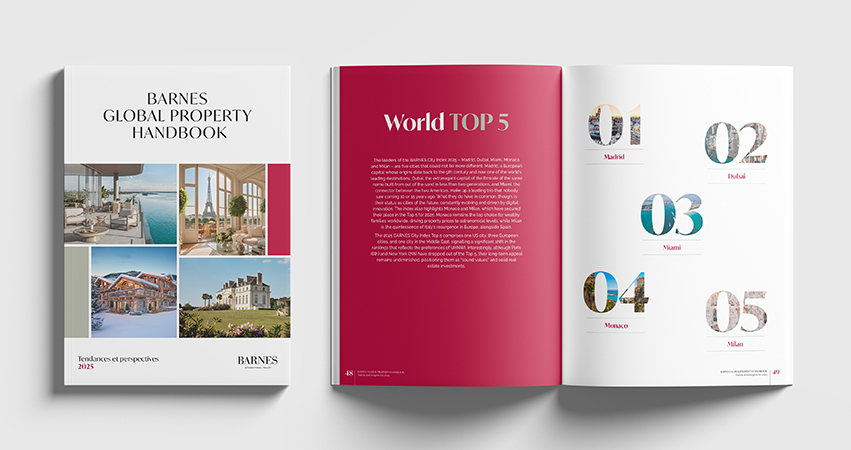
In this context, the 2025 rankings reshuffle the deck. Madrid, which ranked 4th in the BARNES City Index in 2024, takes first place this year. A consecration for the Spanish capital, which now becomes the most attractive European city, ahead of London and Paris—long thought to be unshakeable benchmarks. Notably, three “cities of the future” feature in the Top 10: Dubai in second place, Miami in third, and Austin in tenth.
In First Place: Madrid—Connected, Festive, Cultural and Gastronomic
Cosmopolitan, joyful and vibrant, Madrid has moved from 4th to 1st place in the Top 5 of the BARNES City Index 2025. Its quality of life, low crime rate, pleasant climate, free public services, top-tier healthcare, quality education and excellent transportation system make it a favored place of residence for buyers worldwide.
While the Spanish capital hosts the headquarters of some of the country’s largest companies, it is also the fourth European city in terms of the number of multinational headquarters. A growing number of companies and investment funds are setting up there, seeing Madrid as a city to bet on for the future.
As a result, Madrid is home to a highly qualified foreign population, up 20% since 2016. This population particularly favors the Salamanca district for its large family apartments, luxury boutiques and fine dining; Chamberí for its calm atmosphere and numerous shops; Chamartín, which is gaining recognition as a new trendy residential neighborhood; and Cortes–Las Letras, a lively and festive area. Depending on location, prices have risen by 11% (Chamberí) to 19–20% (Cortes and Salamanca).
“The appeal of Madrid as a hub for high-end real estate continues to grow. With a favorable investment climate and a steady increase in foreign buyers, the city is consolidating its status as a prime destination for luxury properties. Its dynamic market reflects both its cultural appeal and its promising economic outlook,” says Alvise Da Mosto, Managing Partner of BARNES Spain.
To watch in 2025: Madrid’s dominance could be challenged by Prime Minister Pedro Sánchez’s announcement of a proposed tax on real estate purchases made by non-European buyers.
What can you buy with €1 million?
-
A renovated 80 sq.m apartment in the most sought-after districts—if you can find one.
-
A beautiful 100 sq.m apartment in the Chamberí district.
2nd Place: Dubai, the Ultimate City of the Future
After being the first Middle Eastern capital to top the BARNES City Index last year, Dubai has been overtaken by Madrid in 2025. The former Emirati fishing port has, over the decades, transformed itself into one of the world’s leading tourist and economic destinations, as well as a major financial and business hub.
This entrepreneurial city boasts a predominantly young population (in 2024, 68.62% of Dubai’s population, including expatriates, was aged between 25 and 54) and is 92% expatriate. Its population has grown at an average annual rate of 4–7% for nearly 30 years (+4% in 2024).
A global hotspot for luxury real estate, Dubai is now one of the must-have locations for UHNWI—cities where owning property is considered essential. Unsurprisingly, prices continue to rise: +15% in 2024. Constantly evolving, Dubai plans to transform 60% of its residential land into green spaces by 2040, a move that strongly appeals to environmentally conscious international buyers.
They are also attracted by a highly favorable tax system: resident expatriates are exempt from income tax, and VAT stands at just 5%. Since 2023, a 9% corporate tax has been gradually introduced on profits exceeding AED 375,000 (just under €100,000), still well below the global average.
Buyers mainly seek family villas “on the water” (near lagoons), properties overlooking golf courses, and penthouses with panoramic views. New developments offering luxury amenities and futuristic architecture are also highly popular.
“Dubai is one of the safest cities in the world. The population lives in complete peace of mind, which is a key argument for buyers, especially families,” says Lorraine Soulier, International Director of BARNES Dubai. The artificial Palm Jumeirah archipelago, shaped like a palm tree with 16 fronds and famous worldwide for its aerial views, is particularly popular with both local and international buyers.
What can you buy with USD 1 million?
-
Dubai Creek Harbour: an 85–90 sq.m one-bedroom apartment
-
Business Bay: a 150 sq.m two-bedroom apartment
-
Springs: a 150 sq.m two-bedroom villa
Miami: Sun-Seeking, Lifestyle and Ultra-Connectivity
With a thriving economy, recognized quality of life, top-tier healthcare and education, exceptional tax advantages (no personal income tax and a 5.5% corporate tax), and a still reasonably priced luxury market, Miami remains firmly anchored in the Top 5 of the BARNES City Index, slipping from 2nd to 3rd place.
The widespread adoption of remote work has highlighted the city’s strengths, making it a favorite among tech companies and hedge funds. Beyond Miami Beach, buyers are turning to emerging neighborhoods (such as Edgewater) and areas with proven rental yields (notably Brickell).
“Digital, sporty, gastronomic, festive and cultural, Miami combines all the assets needed to remain one of the world’s most sought-after cities for entrepreneurs and wealthy families. French clients, in particular, are very attracted by its quality of life and the excellent standard of its international schools,” emphasizes Enzo Rosani, Managing Partner of BARNES Miami.
The supply of luxury properties in Miami is abundant. The most sought-after assets are waterfront villas with private docks on secure private islands, and penthouses offering panoramic views of Biscayne Bay or the ocean. Investing in high-end new developments is particularly attractive, as continuous price increases often result in immediate capital gains upon delivery.
What can you buy with USD 1 million?
-
Miami Beach: a 100 sq.m apartment
-
Miami Mainland: a 120 sq.m apartment
-
Coconut Grove: a 90 sq.m apartment
-
Key Biscayne: a 110 sq.m apartment
Monaco: Glamour, Modernity and… Environmental Responsibility
“People settle in Monaco for its security, political and economic stability, and tax attractiveness,” says Florian Valeri, Managing Partner of BARNES Monaco. Ranked 4th in the BARNES City Index, Monaco is indeed a model in terms of security—both digital and physical—with full territory coverage by video surveillance and the highest ratio of police officers per capita in the world.
It also benefits from a favorable tax system, with no income tax, inheritance tax or capital gains tax on real estate for individuals. Fiscal conditions are also advantageous for companies. A stable economic climate, with no public debt, further enhances its appeal to investors and wealthy residents worldwide.
Living in Monaco also means enjoying a strong cultural, sporting, festive and gastronomic scene. The Principality places great emphasis on social cohesion and demonstrates a strong commitment to environmental protection and sustainable development, both nationally and internationally. This commitment is reflected in real estate developments such as Mareterra, located in the Anse du Portier eco-district—an innovative project designed to meet international sustainability standards.
Covering just two square kilometers, Monaco is unique in the world. Its real estate market remains the ultimate safe haven and continues to grow in attractiveness over time, despite extremely high prices per square meter (€40,000 to €100,000 or more), which have increased by 38% over the past ten years. Fontvieille, Larvotto and Monte Carlo’s Carré d’Or are particularly popular neighborhoods. Numerous high-end residences are currently under construction or have just been delivered. Apartments and villas in the emblematic Mareterra eco-district, despite prices ranging from €90,000 to €120,000 per sq.m, have no difficulty finding buyers.
What can you buy with €1 million?
-
A 25 sq.m studio in a mid-range luxury building.
Milan: At a Crossroads
Over the past two decades, Milan’s luxury real estate market has evolved significantly.
“In less than a generation, Milan has managed to shed its outdated image and establish itself as one of the major destinations on the global luxury real estate map. The quality of life in its historic center is unparalleled,” says Luca Pietro Ungaro, Director of BARNES Business Development Italy.
A hub of international fashion and design, the Lombard capital also benefits from an ideal geographical location between sea and mountains, attracting international wealth. Its economic dynamism, combined with the quality of its historic urban fabric, reasonable prices for luxury real estate (€9,000 to €21,000 per sq.m for exceptional properties), high-quality international schools, cultural life and gastronomy, all contribute to firmly anchoring Milan in the searches of UHNWI families—and to its entry into the Top 5 of the BARNES City Index in 2025.
The Milanese market is highly diversified, ranging from apartments in restored historic buildings to centuries-old palaces and contemporary residences with high-end amenities. Foreign buyers are looking for large apartments in architecturally distinguished buildings, on higher floors, bright, with terraces and parking spaces—properties that are hard to find.
What can you buy with €1 million?
-
A 120 sq.m apartment in the Centro Storico
-
A 180 sq.m apartment overlooking Parco della Resistenza
BARNES CITY INDEX 2025
-
Madrid (4)
-
Dubai (1)
-
Miami (2)
-
Monaco (12)
-
Milan (17)
-
Paris (5)
-
New York (3)
-
London (6)
-
Rome (=)
-
Austin (7)
-
Abu Dhabi (13)
-
Budapest (14)
-
Geneva (11)
-
Istanbul (10)
-
Tokyo (16)
-
Athens (33)
-
Zurich (15)
-
Dallas (22)
-
Singapore (20)
-
Stockholm (21)
-
Copenhagen (18)
-
Barcelona (19)
-
Doha (35)
-
Vienna (25)
-
Lisbon (8)
-
Dublin (=)
-
Los Angeles (24)
-
Amsterdam (42)
-
San Diego (28)
-
Brussels (29)
-
Munich (27)
-
Seoul (31)
-
Oslo (32)
-
Florence (46)
-
Malaga (Marbella) (47)
-
Sydney (=)
-
Luxembourg (new entry)
-
Mumbai (41)
-
Boston (38)
-
Montreal (34)
-
Beijing (39)
-
Hong Kong (23)
-
Mexico City (49)
-
Riyadh (new entry)
-
Auckland (45)
-
Toronto (43)
-
Bangkok (40)
-
Shanghai (new entry)
-
Shenzhen (44)
-
Washington (30)
In bold: cities that moved more than ten places in 2025 vs. 2024
(=) Position in the 2024 ranking
Discover the Global Property Handbook 2025