Asking Price, Final Price: Which Properties Can You Negotiate On in Marrakech?
- By Barnes Marrakech
- 29 Octobre 2026
Asking Price, Final Price: Where to Negotiate in Marrakech?
In Marrakech, the gap between asking price and final sale price does not depend on how much a property costs, but on how rare it is. A contemporary, correctly priced front-row golf villa sells at the listed price. A developer-built villa, offered in dozens of examples that are comparable in architecture, design and price, sells after negotiation. Between the two, everything comes down to the number of equivalent properties available at the time of sale. This way of reading the market surprises many foreign buyers, who are used to markets where negotiating is a matter of principle.
Where these observations come from
This analysis draws on two sources, which should not be confused. The first is our survey of asking prices in September 2026, covering nearly 1,800 high-end properties, presented in our September 2026 article on prices, areas and market logic. The second is the mandates and files handled by BARNES Marrakech over the last twelve months, which give the prices actually signed. The gaps described here come from that portfolio, from the rarest properties to Palmeraie land and Royal Palm villas. Conversions use the Bank Al-Maghrib rate of 21 September 2026: €1 = MAD 10.9343.
Land: a shrinking supply
This is one of the tightest segments of the high-end market. On golf estates, only two to three plots change hands each year, and supply is drying up: at Royal Palm, no plot is currently available. Owners know how scarce land is, which explains the sharp rise in prices over the past two years.
On these properties, the final price generally matches the asking price, especially on the most sought-after locations. Away from the front line, a margin of around 5% can appear, and up to 10% on a more ordinary location. Value depends less on surface area than on the characteristics of the plot: its precise location, number of street frontages, quality of the boundary wall, existing vegetation and immediate surroundings. In the Palmeraie, where one hectare is needed to build, a premium hectare is valued at around MAD 15 million; a hectare in the Golden Triangle, with two frontages, a well-kept boundary wall and an olive grove already planted, sold for MAD 20 million. And time works against the buyer: with supply this limited, anyone who hesitates may see the land go to another candidate, whether it is land for sale in the Palmeraie or land for sale in Amelkis.
Golf villas: front-row sells at the asking price
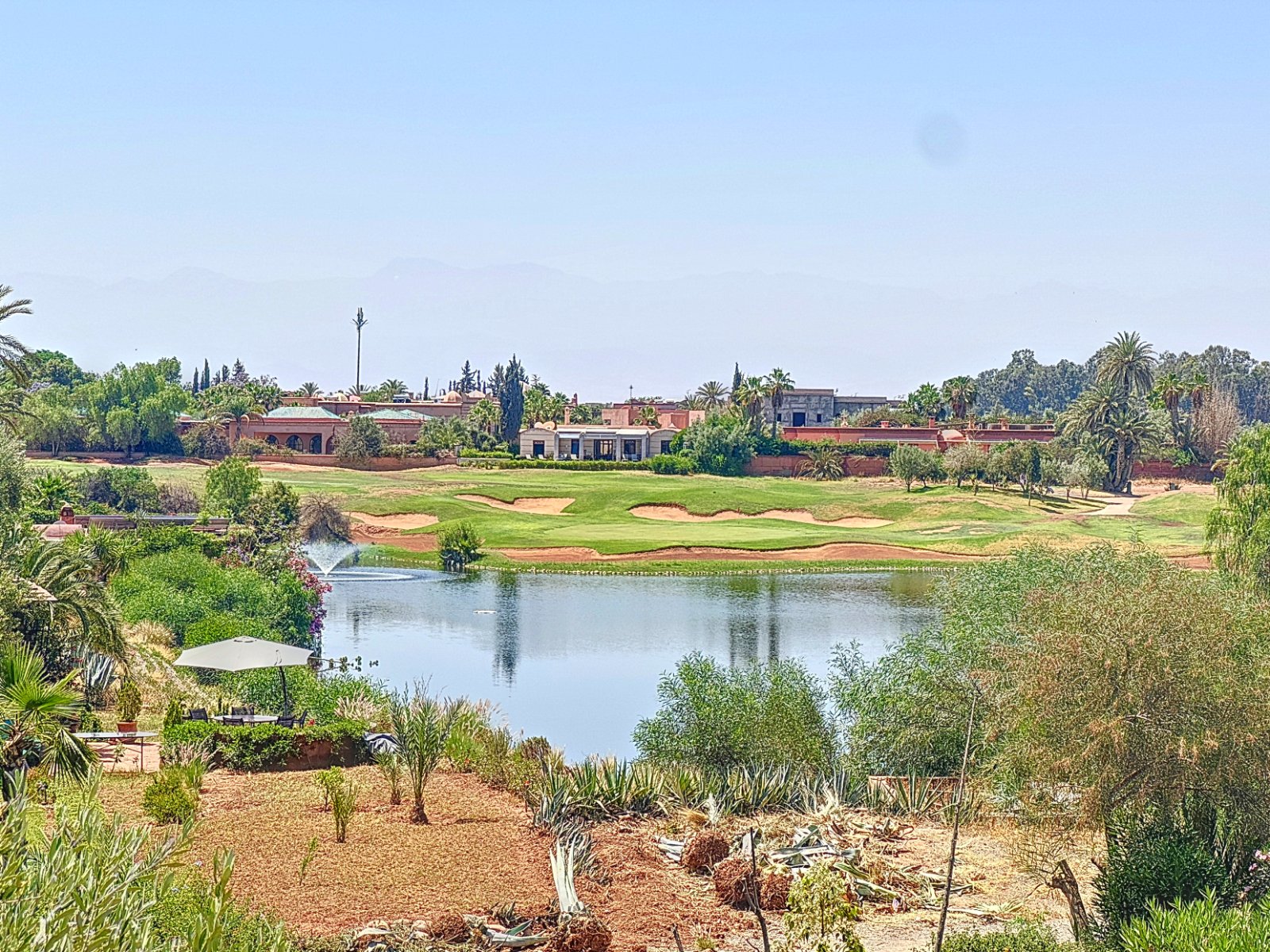
Among golf villas, a new villa or one nearing completion, on the front line and with carefully designed architecture, sells at the asking price, on one condition: that the price matches the market.
Two recent files handled by BARNES Marrakech confirm this. In Amelkis, a front-row villa nearing completion, on 2,000 m² of land, sold with no discussion of the price. In Al Maaden, for a contemporary villa nearing completion on 2,800 m², the buyer made several offers over six months and the owner held his price. The buyer eventually acknowledged that the price matched the market for this category of villa, and bought at the original asking price. This file shows the importance of a fair price from the day of listing.
At Royal Palm, where villas are in high demand and offers are rare, the final price equals the asking price or differs from it by less than 5%.
Palmeraie: time rather than a gap
In the Palmeraie, negotiation remains limited on high-end villas. For a villa to renovate listed at around €4 million, the gap between asking price and final price is around €100,000 to €150,000. On new or recent villas, it is often between 0 and 5%, but the time to sell is longer than for a front-row golf property.
The reason is not the quality of the product but the entry ticket: between €4 and €6 million, the number of buyers able to acquire this type of property at any given moment remains very limited. An owner whose property is correctly positioned can therefore hold the price and wait for the right buyer. The scarcity of both supply and demand lengthens the selling time of Palmeraie villas, without leading to any significant price drop.
Upscale apartments: scarcity lies in the product, not the neighborhood
For apartments, the margin depends on the quality and rarity of the property more than on the neighborhood. In the Hivernage, a premium apartment sells around 5% below the asking price, while properties in the neighborhood's best-known residences generally sell at market price. An apartment to renovate in the same neighborhood is listed at between MAD 22,000 and 25,000 per square meter, with a slight gap of MAD 500 to 1,000 per square meter, corresponding to the cost of the work to be done.
In Guéliz, a developer generally holds the listed price on a new program. Some apartments, however, combine sought-after assets (open views, large terrace, high floor, prime location) that set them apart: their rarity often lets them sell at the asking price, in a short time.
Conversely, in less exclusive areas and in estates without a golf course, where comparable properties are numerous, the margin can reach 5 to 10%. This is not a question of quality, but of the relationship between the product's rarity and the volume of supply.
Developer-built villas: when supply becomes abundant
This is the only segment where the balance of power is reversed. Production is high, stock is large and supply is uniform from one project to the next (same style, same construction, same price range): the buyer has room to negotiate. It is then better to favor a completed or well-advanced project, because the saving made on a development at its launch phase is often paid for in delays and uncertainty over the delivery date.
The medina: a market returning to normal
Over two years, prices of riads to renovate have risen sharply, doubling in some segments. Three factors explain this: the scarcity of premium product in the medina, a high rental yield and the arrival of several investors on the same properties. A year ago, a well-located premium riad sold at the asking price, and quickly.
For the past six months, the pace has been normalizing. Prices are not falling, but viewings are spacing out, and serious offers are arriving 5 to 7% below the asking price for a premium medina property, and up to 10% in the standard medina. A well-advised seller adapts their strategy accordingly. A genuinely committed buyer should put their offer in writing quickly, rather than let one of the riads for sale in the Medina they have spotted go to another buyer.
How long does it take to sell?
A correctly positioned property can sell in under six months in Marrakech when two conditions are met: a price in line with the market and architecture in line with what buyers want at the time. The front-row villas in Amelkis and Al Maaden mentioned above sold before the end of construction. Another Amelkis villa, off the front line, with 400 m² built on 1,300 m² of land, sold for MAD 14 million while it too was still being finished, because its characteristics matched exactly what the market was looking for when it was listed.
Building to sell: start from demand
Part of a development's commercial success is decided before the first shovel hits the ground: positioning, architecture, volumes, specifications and price must all be designed starting from demand. Many developers and investors start a build without consulting those who know the buyers (the sizes they ask for, the prices that can be reached, the style that sells), then hand the property over for marketing. The location, price or style then do not always fit, or the product resembles others delivered at the same time.
In the high-end market, the logic is the reverse of volume: a buyer with strong purchasing power looks for a singular property. A development designed from demand, well located and with identifiable architecture, sells before it is finished, while an average product takes time to find a taker. A conversation with an agency before the plans are finalized can noticeably shorten the time to sell.
Seller side: recognizing a good offer
In a demand-driven market, an owner who receives an offer at or near their asking price may think they will get better. For nearly two years, the market has supported that idea. The pace is now normalizing: viewings are spacing out, proposals are becoming rarer, and an offer turned down a few months ago does not necessarily come back. The property has lost none of its qualities; it is the number of genuinely committed buyers that has fallen.
Timing therefore matters as much as the listed price. A written, serious offer in line with the market deserves to be examined, rather than dismissed in favor of a rise that nothing guarantees. The question is not only "can I get more?", but also "by when, and at what carrying cost?": running costs, taxes, upkeep, tied-up capital. Hence the value of a regular valuation, even with no immediate plan to sell, to have an objective benchmark the day an offer arrives.
How to recognize a rare property?
No signal in a listing lets you recognize a rare property. Rarity is measured by comparison: a buyer who visits for a few weeks, through several agencies, ends up perceiving it. They see the same products come back, or on the contrary find nowhere the equivalent of what they visited. Comparing our properties for sale in Marrakech, area by area, is the first step. It is also the role of the advisor who accompanies them: to say whether the price is consistent, and where to position.
The most frequent mistake comes from a lack of benchmarks, which is normal when discovering a market: offering less on principle on a property that is already correctly valued can lose a fine opportunity. The right question is not whether to make an offer, but whether the property can withstand the wait that such an offer entails. Our purchase procedure details how a written offer, signed by both parties, locks in the negotiation before the appointment with the notary.
Limits of this analysis
These observations describe Marrakech's high-end segment in the third quarter of 2026, based on our portfolio. They do not apply to the mainstream residential market. On the rarest segments, they rest on a small number of files, which rules out any statistical claim: a recovery in medina demand, or the arrival of two more plots on a golf estate, would be enough to change the picture. Reference prices by area are on our Marrakech property prices page.
Analysis written by Karim El Baroudi, managing partner of BARNES Marrakech, based on the mandates and transactions handled by the agency and on the September 2026 asking-price database. Published 21 October 2026. Next update scheduled for the first quarter of 2027.
Are you an owner? Knowing what your property is worth today also means knowing how to recognize a good offer the day it arrives. Request a valuation
Buying, or building to sell? An opinion on a property's positioning before making an offer, or on sizes, style and achievable price before the plans are filed, saves time, and sometimes the deal itself. Contact us